

Why tertiary hospitals play such an important role in Chinese healthcare
International patients researching healthcare in China quickly encounter a term that appears everywhere — in discussions of cancer treatment, specialist consultations, complex surgery, and almost any conversation about serious medical care.
Tertiary hospital.
Sometimes it appears as “Class 3A” or “三甲.” Sometimes it’s described simply as a “top-tier” institution. The term is used so consistently, and with such implicit weight, that it’s easy to assume its meaning is obvious.
It isn’t, not to someone approaching Chinese healthcare from the outside. And the gap between assuming you understand what a tertiary hospital is and actually understanding it turns out to matter — because the tertiary hospital system is the structural feature of Chinese healthcare that explains more about how the system works than almost anything else.
What the tier system actually describes
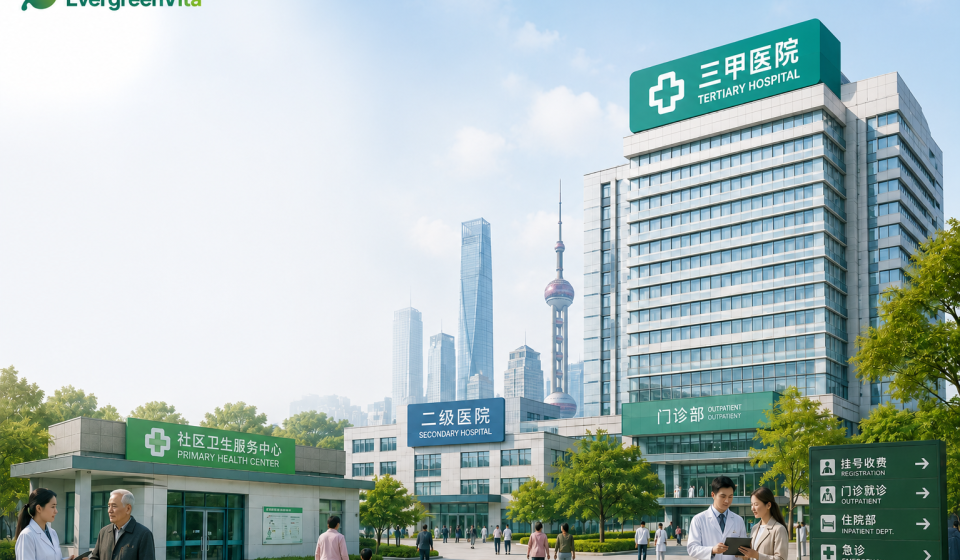
China organizes its hospitals into a tiered structure based on institutional capacity, clinical capability, and the role each type of institution is designed to play.
At the base are primary care facilities — community health centers, township clinics, the local institutions that handle routine medicine, chronic disease management in stable patients, preventive care, and basic health needs. These are designed to be geographically accessible and to function as the first point of contact with the healthcare system for most people most of the time.
Above them are secondary hospitals, which serve larger geographic areas — a district or county — and handle a wider range of conditions than primary facilities can manage. They’re more capable than local clinics but less specialized than the institutions at the top of the system.
Tertiary hospitals sit at the apex. These are the large, complex institutions designed to handle what the lower tiers cannot: difficult diagnoses, major surgical interventions, rare or unusual presentations, conditions that require specialist expertise and technical infrastructure that can only exist at scale. They are typically the hospitals affiliated with major medical universities, functioning simultaneously as clinical centers, research institutions, and training grounds for the country’s medical workforce.
Within the tertiary tier, there is further gradation. A Class 3A designation — the highest in the system — indicates that a hospital has met the most stringent criteria across institutional scale, departmental breadth, clinical capacity, research output, and quality metrics. It is the tier within the tier that carries the most weight in patient decision-making and in the organization of China’s most demanding medical work.
Tertiary hospitals are designed to provide advanced medical services, specialist care, and complex treatments — but they are also where medical knowledge is generated and transmitted. That dual function is part of what makes them structurally different from simply being large hospitals.
Why so much concentrates here
The concentration of resources, expertise, and patient volume at China’s tertiary hospitals didn’t happen by accident. It is the product of how medical training, research funding, and institutional reputation have developed over decades.
China’s major medical universities train their graduates in affiliated tertiary hospitals. The most talented physicians build their careers at institutions where the case mix is most complex, where research is most active, where the academic and clinical environments reinforce each other. Over time, this produces institutions where the depth of specialist expertise — measured in the number of cases seen, procedures performed, and rare presentations managed — far exceeds what is available at lower-tier institutions.
Equipment follows expertise. Major tertiary hospitals have access to imaging technology, surgical infrastructure, and diagnostic capability that smaller institutions don’t. Research programs generate clinical trial access that gives patients options not available elsewhere. The training ecosystem means that a senior specialist at a major tertiary hospital is embedded in a network of colleagues, residents, and researchers that keeps clinical practice closer to the leading edge of medicine.
The result is a system where the gap between tertiary hospitals and the institutions below them, particularly in specialist medicine, is substantial. And because patients understand this — because the reputation of these institutions has been built through real outcomes, transmitted through the social networks of families and communities — demand concentrates at the top of the system.
Why people travel so far to get there
One of the most visible features of China’s tertiary hospital system is geographic mobility — patients who travel not just across a city but across provinces to access care.
This is not irrational behavior, and it’s not primarily driven by distrust of local medicine. It reflects a straightforward calculation: for a condition that requires specialist expertise, the depth of that expertise matters, and the depth is concentrated in ways that don’t respect provincial boundaries.
A patient in a rural area of Yunnan facing a complex cancer diagnosis may have access to competent local medicine, but the oncologist with the deepest experience in that specific tumor type may be in Chengdu, or Shanghai, or Beijing. The patient and their family make the calculation — travel cost, accommodation, disruption to daily life — against the clinical benefit of being treated by the most experienced team available. Many decide the journey is worth it.
Patients often travel not because care is unavailable locally, but because specialist expertise is concentrated within tertiary hospitals in ways that local institutions cannot replicate. The geography of Chinese healthcare is a geography of expertise, not just of hospitals.
This is why the waiting rooms at the most prestigious tertiary hospitals contain people from everywhere. A patient sitting next to someone in the queue at a Beijing cancer center may have traveled from Heilongjiang in the northeast, while the person behind them came from Guangxi in the south. The institution hasn’t just attracted local demand — it has become the destination for national demand in its area of specialty.
Why tertiary hospitals are always crowded
The crowding that international patients encounter when they arrive at a major Chinese public hospital is not a sign of poor management. It is the direct and predictable consequence of the system’s structure.
When expertise is concentrated in a small number of institutions, demand concentrates there too. When those institutions have reputations built over decades of outcomes, trust concentrates there. When the gap between tertiary hospitals and the alternatives is real and meaningful, patients with the ability to choose — which, in a country with good transportation infrastructure and deep family networks oriented around supporting health-seeking behavior, is many patients — choose the institutions with the highest concentration of what they need.
The result is patient volumes at major tertiary hospitals that would seem extraordinary by the standards of healthcare systems organized differently. Thousands of patients moving through a single building on a single day. Specialist departments where the waiting list reflects genuine scarcity of a specific kind of expertise, not administrative inefficiency.
Understanding why Chinese hospitals often feel crowded requires understanding this — that the crowding is a signal rather than a symptom. It indicates that patients have judged this to be worth getting into, not that the system has failed to manage demand. The two can coexist: a system that is genuinely difficult to navigate and simultaneously worth navigating.
What international patients need to understand
For international patients entering the Chinese healthcare system, the tertiary hospital is often both the destination and the source of the greatest navigational challenge.
The destination, because for any condition of meaningful complexity — a cancer diagnosis, a major surgical indication, a condition requiring specialist depth — the appropriate care is likely concentrated in a tertiary hospital. The logic that applies to Chinese patients applies equally to foreign ones: if the expertise needed is at the top of the system, that’s where the care needs to happen.
The challenge, because tertiary hospitals were built for the domestic patient population. Their registration systems, appointment pathways, payment processes, and departmental structures assume a familiarity with how Chinese healthcare works that international patients don’t arrive with. Securing an appointment with the right specialist, in the right department, at an institution where the relevant expertise actually resides — this is a process that requires either that familiarity or a way of compensating for its absence.
For international patients, understanding tertiary hospitals provides a clearer picture of how advanced healthcare is accessed in China. It explains why the hospitals that are most worth accessing are also the hardest to navigate — why the queues are longest at the places with the strongest reputations, and why choosing a simpler access point may mean accepting a different level of clinical depth.
The international departments and VIP clinics that exist within major tertiary hospitals are partly a response to this. They provide a different entry point into the same clinical resources, with more accessible processes and more English-language support. The trade-off is that they don’t eliminate the complexity of the underlying institution — they provide a different way of approaching it.
What tertiary hospitals actually are
It’s worth being direct about this, because the term itself can obscure it.
Tertiary hospitals are not simply large hospitals. They are key institutions through which specialist expertise, medical education, and advanced care are delivered — not just in their own cities, but often across entire regions of the country.
The oncologist at a major Shanghai tertiary hospital is not only treating patients in Shanghai. The knowledge they generate through their research affects how cancer is treated in hospitals that trained their physicians there. The guidelines they contribute to shape practice nationally. The residents they supervise become the specialists who staff hospitals across the country when they complete their training.
This is why the tertiary hospital system is described as the backbone of Chinese healthcare rather than simply its top tier. It generates the knowledge, trains the people, and concentrates the expertise that makes the rest of the system function at the level it does.
For international patients, this means that engaging with a major tertiary hospital is engaging with something that exists at a different scale than the concept of “hospital” usually implies — an institution whose influence on Chinese medicine extends far beyond its walls, whose clinical reputation reflects not just what happens in its consultation rooms but what it has contributed to the field over decades.
Discussions about healthcare in China often focus on individual hospitals — which one is best for a particular condition, which city has the strongest institutions. That focus is understandable, because it addresses the immediate practical question: where should I go?
But understanding the tertiary hospital system provides something the individual hospital question doesn’t: a framework for understanding why Chinese healthcare works the way it does, why patients make the decisions they make, and why the most capable institutions are simultaneously the most crowded and the most difficult to enter.
That structural understanding is what EvergreenVita has been building toward across this series — because the patients who navigate Chinese healthcare most effectively are usually the ones who understand not just where to go, but why the system is organized the way it is, and what that organization means for the choices available to them.
Explore more insights into China’s healthcare system at China Medical Insights.
Related Reading
[Why Chinese Patients Trust Public Hospitals] — Understanding the relationship between public trust and healthcare choices in China.
[Why Chinese Hospitals Feel Overwhelming to Foreign Patients] — How patient volume connects to healthcare structure.
[How Foreign Patients Access Healthcare in China] — The pathways international patients use to enter China’s healthcare system.
© EvergreenVita(青禾焕生健康国际) – China Medical Insights
This article may be shared or republished for non-commercial purposes, provided that full attribution is given to EvergreenVita and the original source link is included.
Commercial use, modification, or redistribution without prior written permission is prohibited.
Original source:
www.rebirth-everyone.com


